E2B Alternatives for AI Agent Sandboxes (2026)
By Utpal Nadiger · July 20, 2026
E2B fixes a sandbox's CPU and RAM when you build its template, and there is no API call to change them while it runs. Growing a sandbox from 2 GB to 8 GB means you rebuild the template and launch a new one.
E2B has two more limits. Sessions cap at one hour on Hobby and 24 on Pro, and the bill scales with concurrency.
This piece works through eight sandbox providers and compares them on four axes:
- live resize
- persistence
- isolation
- price
The sandboxes here fall into three isolation tiers:
- A microVM is a lightweight virtual machine with its own kernel, booted fast by a hypervisor like Firecracker, which AWS built to run Lambda and Fargate and open-sourced in 2018.
- A container shares the host kernel and isolates with Linux namespaces.
- gVisor sits in between, a user-space kernel that intercepts syscalls.
The microVM tier exists because containers are not a real security boundary and a full VM boots too slowly to sit in a request path. OpenComputer's own sandbox fingerprinting writeup walks through how six vendors' isolation models differ, which matters when you run untrusted agent-generated code.
What are E2B's structural limits?
E2B has three structural limits:
- a sandbox's CPU and RAM are locked in at template build time and cannot grow while it runs
- sessions cap at 1 hour on Hobby and 24 hours on Pro
- compute billing scales with concurrency
The first is the main one, but a workload whose size never changes does not hit it.
Why do E2B sandboxes make you rebuild to change CPU or RAM?
CPU and RAM are fixed at template build time, so changing them means building a new template. In E2B you set compute by building a custom template with the CLI, passing e2b template build --cpu-count --memory-mb, and those values are baked into the template.
The sandbox lifecycle API gives you five calls:
- create
- pause
- resume
- set-timeout
- kill
None of them changes the CPU or RAM of a running sandbox, so to go from 2 GB to 8 GB you rebuild the template and launch a new sandbox at the new size.
A stable requirement never hits this, so if your agent always needs 4 GB, a 4 GB template covers it.
An agent that idles at 1 GB for an hour and then needs 12 GB for one compile step can either provision for the peak the whole time or tear down and relaunch mid-run. The build cap is 8 vCPU and 8 GB on Hobby, higher on Pro by request.
OpenComputer's post on what elastic compute means explains why agentic workloads don't fit the fixed-size assumption behind traditional cloud sizing.
What does E2B still do well?
E2B is the incumbent, and if your integration works with stable sandbox sizes it hits none of those limits. Moving off a working integration also costs engineering time.
E2B (e2b.dev) gives you Firecracker microVMs on a mature SDK. Each sandbox is a real microVM with its own kernel, so the isolation boundary sits at the hypervisor level rather than in shared-kernel namespaces.
Its documentation is the most complete in the space, and its SDK has the widest framework integration coverage in this group.
Persistence works through pause and resume. When you pause a sandbox, E2B saves both the filesystem and memory state, so running processes and loaded variables come back intact.
Resume takes about a second, while pausing takes roughly 4 seconds per 1 GiB of RAM. Paused sandboxes are now kept indefinitely with no automatic time-to-live, so you explicitly kill one to release it.
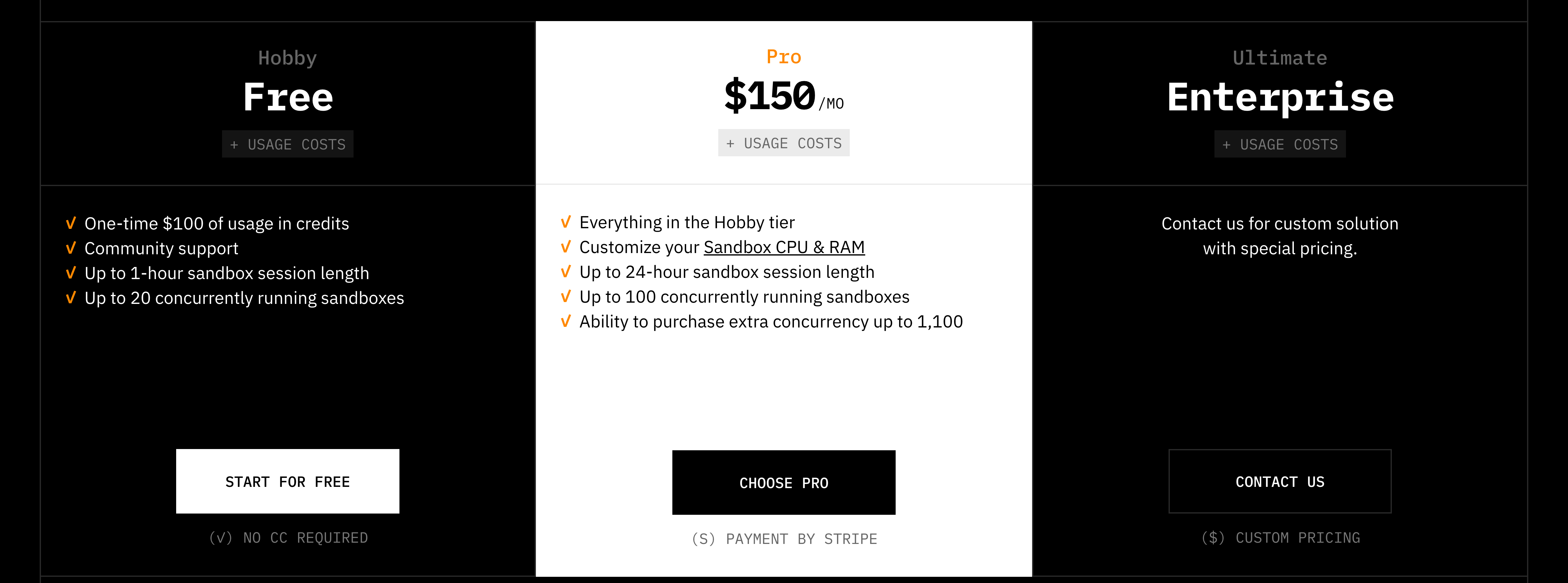
The pricing is usage-based on top of a plan. On the pricing page, the free Hobby tier gives you:
- a one-time $100 credit
- a 1-hour max session
- 20 concurrent sandboxes
- 10 GiB of storage
Pro is $150/mo. It extends sessions to 24 hours and raises concurrency to 100 (expandable to 1,100).
Compute meters at $0.000014 per vCPU-second ($0.0504/vCPU-hr) and $0.0000045 per GiB-second ($0.0162/GiB-hr).
Which E2B alternatives are worth comparing?
The eight providers here all run agent code, but each fits a different constraint. Rates in the table are list prices for on-demand compute.
| Provider | Compute price | Isolation | Persistence | Live CPU/RAM resize | GPU | Max session |
|---|---|---|---|---|---|---|
| E2B | $0.0504/vCPU-hr + $0.0162/GiB-hr; Pro $150/mo | Firecracker microVM | Pause/resume snapshot | No | No | 1h Hobby / 24h Pro |
| Daytona | $0.0504/vCPU-hr + $0.0162/GiB-hr; $200 credit | Container (Kata optional) | Stop/archive | Increase only | Yes (H100/H200, RTX) | Configurable |
| Modal | ~$0.142/core-hr + $0.024/GiB-hr (sandbox) | gVisor | Ephemeral | No | Yes (H100/A100) | Configurable |
| Vercel Sandbox | $0.128 active-CPU-hr + $0.0212/GB-hr | Firecracker microVM | Persistent default + snapshots | No | No | 45m Hobby / 24h Pro |
| Morph | MCU-based; $40/mo Developer | Full VM | Snapshot/branch | No | No | Configurable |
| Runloop | $0.108/CPU-hr + $0.0252/GB-hr; Pro $250/mo | microVM/devbox | Suspend/resume | No | No | Configurable |
| Cloudflare | $0.000020/vCPU-s + $0.0000025/GiB-s | Container | Scale-to-zero | No | No | Container lifecycle |
| OpenComputer | $0.004/min flat = $0.24/hr | Real KVM VM (own kernel) | Always-on, hibernate/wake | Yes | No | No timeout |
Two axes separate the providers most. Live resize exists in two places. OpenComputer resizes a running VM up and down. Daytona can increase CPU and memory on a running sandbox, but shrinking them or touching disk needs a stop first. Every other provider fixes size at creation.
Isolation separates the real-VM tier (own kernel) from the shared-kernel container and gVisor tiers. That difference decides how safely each one runs untrusted agent-generated code.
Is Daytona a good E2B alternative?
Daytona is a good E2B alternative when you create and tear down sandboxes constantly, because start latency then dominates your cost. Daytona (daytona.io) is a container-based sandbox tuned for speed, advertising sub-90ms sandbox creation, the fastest cold start in this group.
If you run thousands of short-lived environments, boot time becomes a real share of both cost and latency.
The pricing matches E2B's compute rates almost exactly, at $0.0504/vCPU-hr and $0.0162/GiB-hr billed per-second on active usage. You start with $200 in free credit, and the first 5 GiB of storage is free.
Daytona also runs GPU sandboxes with H100/H200 and RTX types, and a running sandbox can grow its CPU and memory live, though shrinking needs a stop. GPU sandboxes are ephemeral, and the GPU itself cannot be changed after creation.
The tradeoff is isolation, because the default runtime is a container that shares the host kernel. Kata Containers, a real microVM runtime, is available as an opt-in.
The container default is a weaker boundary, so untrusted code belongs on the Kata tier. Persistence is stop-and-archive rather than a live always-on VM, so long-lived state survives through archive cycles instead of in a running machine.
When should you pick Modal over E2B?
Pick Modal when your agent runs GPU inference or heavy batch compute inside its sandbox. Modal (modal.com) gives you GPUs with no separate quota approval step, while E2B has no GPU at all.
The GPU rates:
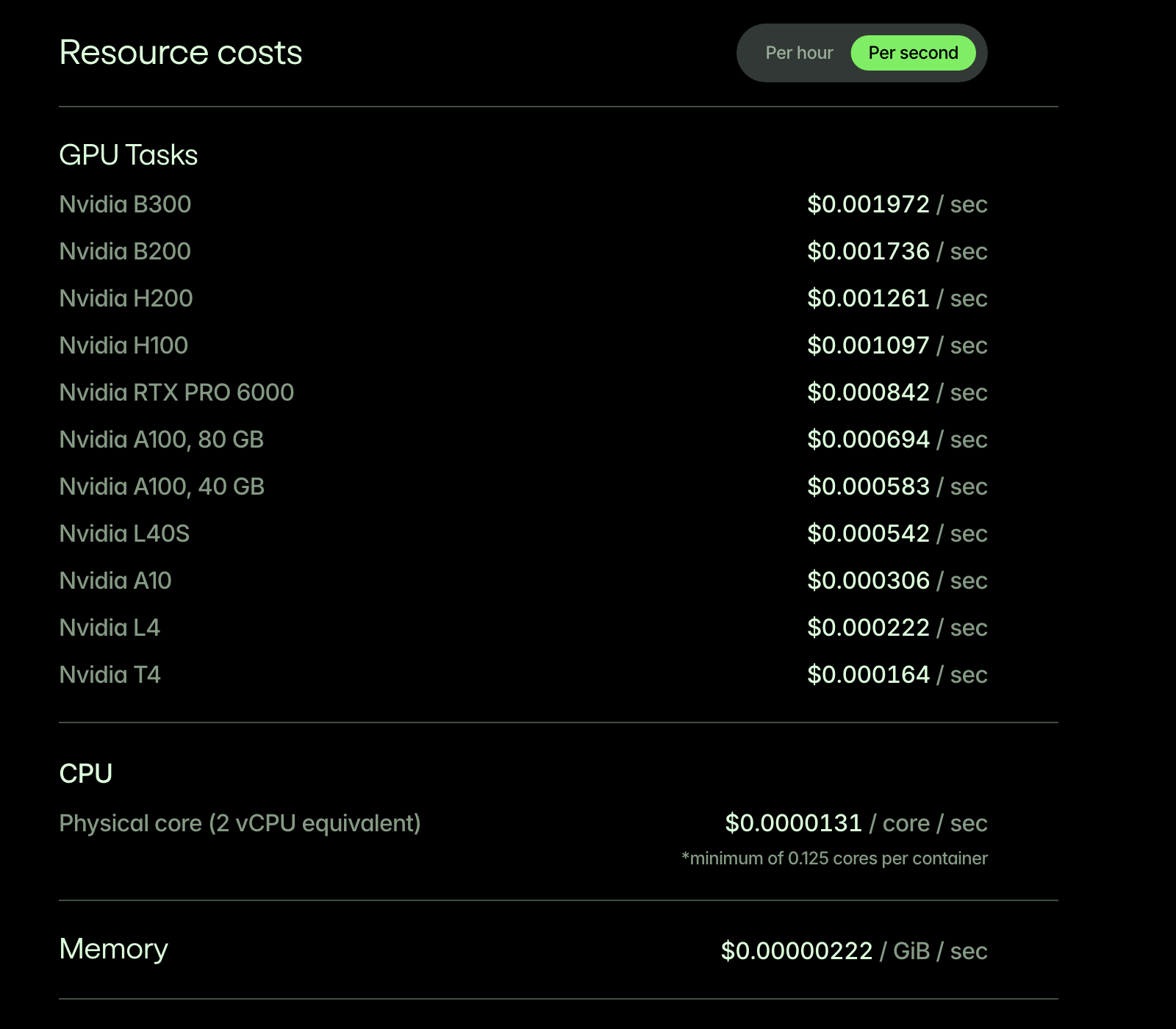
- H100 at roughly $3.95/hr
- A100-80GB at around $2.50/hr
- A100-40GB at around $2.10/hr
Modal Sandboxes bill at about 3x Modal's base compute rate, which comes to roughly $0.142 per core-hour and $0.024 per GiB-hour. The base rate for regular Modal functions is $0.047 per core-hour.
You pay only for active compute, billed by the CPU cycle, so idle time costs you nothing.
The isolation model is gVisor, which is stronger than a plain shared-kernel container but not a full VM with its own kernel.
Sandboxes are ephemeral by default, so persistence across runs is not built in.
Is Vercel Sandbox the right E2B alternative for an app already on Vercel?
Yes, if your app already runs on Vercel, because sandboxes then tie into the project and auth you already have. Vercel Sandbox (vercel.com/docs/sandbox) runs each sandbox in a Firecracker microVM, the same real-kernel isolation tier as E2B.
Sandboxes authenticate to your project automatically through OIDC tokens, so there is nothing new to set up. Billing is on active CPU, which means time the code spends waiting on I/O is not billed.
If your agent spends most of its wall-clock time waiting on an LLM, active-CPU billing costs less than paying for provisioned time. The active-CPU rate is $0.128/hr, with memory at $0.0212/GB-hr.
Persistence is now the default, so sandboxes auto-save state on stop and you resume where you left off. Manual snapshots are available too, and they expire 30 days after last use by default.
Vercel Sandbox is only available in the iad1 region, so multi-region placement and low latency outside US East are out. CPU and RAM are set per sandbox at creation and cannot be resized live.
The remaining constraints:
- max size is 8 vCPU / 16 GB on Pro, or 32 vCPU / 64 GB on Enterprise
- disk is 32 GB and ephemeral
- the default timeout is 5 minutes, extendable to a 24-hour max on Pro
When is Morph the right E2B alternative?
Morph is the right pick when your agent branches one environment into many parallel copies that all continue from the exact same state. Morph (cloud.morph.so) is built around Infinibranch, which snapshots an entire running VM and branches or restores it in under 250ms.
The use case is tree-of-thought agents and parallel evals, where an agent reaches an interesting state once and then forks into dozens of branches that each try a different path without reinstalling dependencies or replaying setup. E2B's pause/resume gives you one saved state to resume, but Morph gives you cheap parallel copies of a live one.
Morph sits on the full-VM isolation tier, and cold start is also under 250ms. Pricing is MCU-based (Morph Compute Units), and one MCU bundles:
- 1 vCPU-hour
- 4 GB of RAM-hours
- 16 GB of disk-hours
Three tiers:
- Free with 300 MCU
- Developer at $40/mo with 1,000 MCU
- Team at $250/mo with 7,500 MCU
MCU pricing does not map directly onto a dollar-per-hour figure, so it is harder to compare against the per-second vendors. If your workload forks environments in parallel, Morph is built for exactly that. For a single durable environment, the branching machinery goes unused.
Which E2B alternative can resize a VM while it runs?
OpenComputer (opencomputer.dev, open source at github.com/diggerhq/opencomputer) is the only entry here that resizes a running VM in both directions. It grows a VM from 1 GB to 16 GB without a restart, then shrinks it back when the spike passes, so you skip the template rebuild and relaunch entirely. Daytona comes closest, growing a running sandbox live but requiring a stop to shrink it.
If your agent idles low and peaks high, you provision for the idle level and pay for the peak only while it lasts.
Each sandbox is a real KVM virtual machine with its own kernel and hardware-level isolation, the strongest tier on this list. Persistence is always-on rather than snapshot-based, so a VM never tears down.
Hibernating a VM and waking it returns the exact state it was in, with no 1-hour or 24-hour cap. OpenComputer also does named, forkable snapshots, so the parallel-branch pattern Morph specializes in is available here too.
Randy Bias popularized the "pets versus cattle" analogy around 2012: cattle servers are interchangeable and disposable, pet servers are kept alive and cared for. Ephemeral snapshot-based sandboxes follow the cattle model. OpenComputer's case for persistent sandboxes inverts the analogy, arguing that an agent holding credentials and hours of built-up context is a pet, so an always-on VM that never tears down beats an ephemeral one re-provisioned on every run.
OpenComputer has no GPUs, so GPU work still goes to Modal. The hosted service currently runs in one region, but the whole stack is open source and built to self-host, which covers the bring-your-own-cloud case.
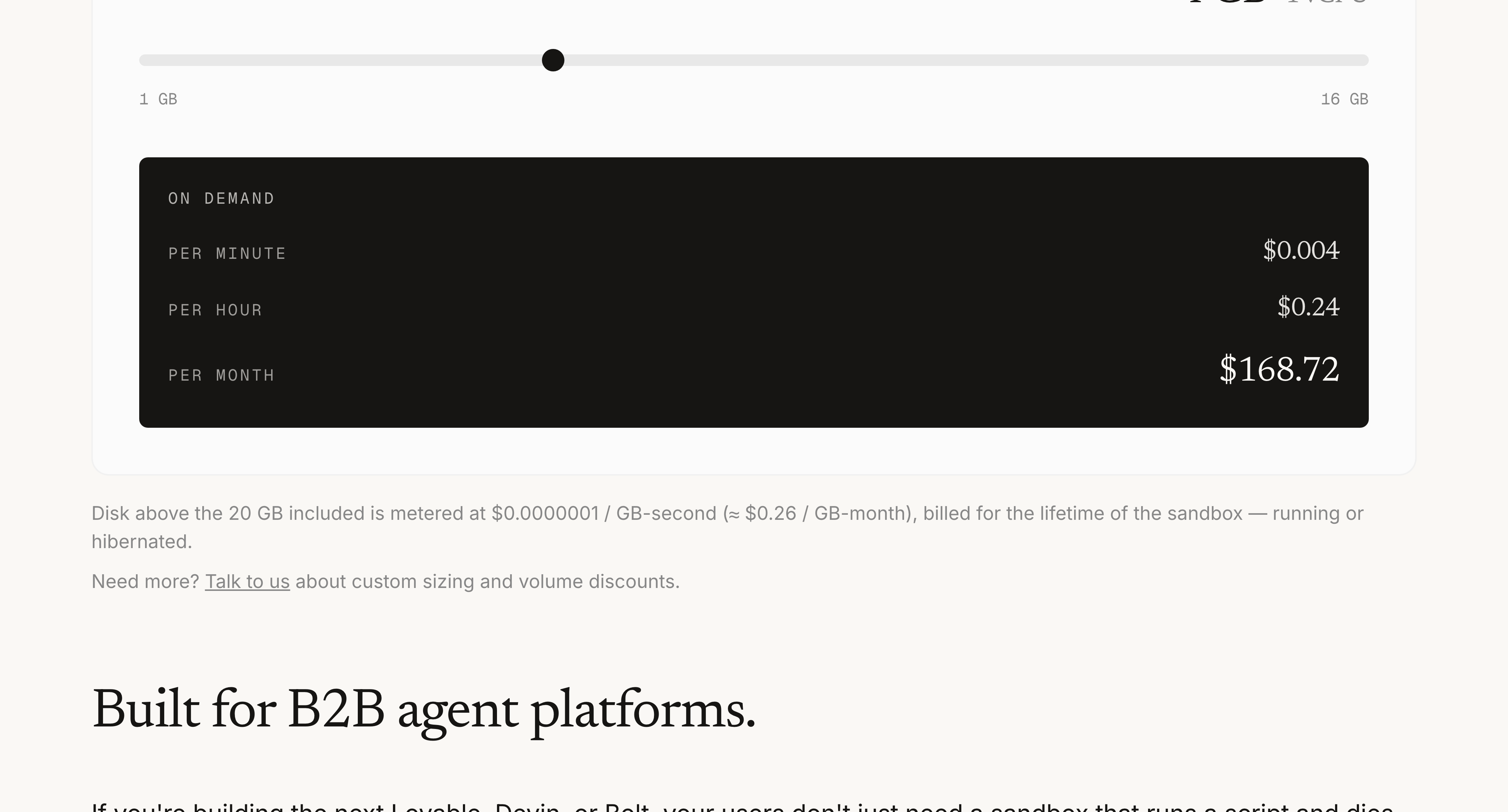
Pricing is a flat $0.004/min, which is $0.24/hr with no plan floor and no monthly minimum. Every VM starts from the same baseline:
- a 4 GB / 1 vCPU default
- RAM resizable from 1 to 16 GB
- 20 GB of disk included
What about Runloop and Cloudflare Sandboxes?
Runloop and Cloudflare Sandboxes each fit one narrow job. Runloop fits coding agents that need compliance certifications, while Cloudflare fits code execution at the edge inside Cloudflare Workers.
Runloop (runloop.ai) is built for coding agents, pairing devboxes with built-in evals against benchmarks like SWE-Bench. It has three compliance certifications:
- SOC2 Type II
- HIPAA
- GDPR
Suspended devboxes drop to storage-only billing, but Runloop is the priciest per-hour here at $0.108/CPU-hr and $0.0252/GB-hr. There is also a $250/mo Pro floor.
Cloudflare Sandboxes (developers.cloudflare.com/sandbox) run on Cloudflare Containers, so isolation is container-tier with a shared kernel.
Billing is scale-to-zero, so charges stop when the container sleeps, at $0.000020 per vCPU-second and $0.0000025 per GiB-second. Instance sizes top out at 4 vCPU / 12 GiB.
If your project is already built on Workers, you get code execution next to your edge logic. If you need stronger isolation, it is the wrong tier.
Which E2B alternative fits which constraint?
Each constraint maps to one provider:
- If you need a GPU, pick Modal or Daytona, since E2B has none. Modal has H100/A100 with no quota approval step, and Daytona runs ephemeral GPU sandboxes with H100/H200 and RTX types.
- If cold-start latency dominates, pick Daytona at sub-90ms creation.
- If your app is already on Vercel and your agents wait on I/O, pick Vercel Sandbox for the project integration and active-CPU billing.
- If you fork one environment into many parallel branches, pick Morph, built around sub-250ms branching.
- If your resource needs swing mid-run, pick OpenComputer, the only one that resizes a live VM in both directions. It also gives you full-VM isolation, always-on persistence, and no session cap.
None of the providers here beat E2B on community size or documentation, and its Firecracker microVM isolation is strong. So if your integration works and your sandbox sizes are stable, you hit none of those constraints and a move costs you engineering time for little return.
E2B's sizing is fixed at template build time. For an agent whose needs change while it runs, OpenComputer removes that constraint and gives you:
- the same real-kernel isolation tier as E2B
- a live resize instead of a template rebuild
- no session cap
- a flat $0.24/hr with no plan floor
FAQ
Is E2B open source?
E2B's SDK and core sandbox tooling are open, and you can self-host parts of the stack, but the managed cloud is the primary product. If you have a hard self-hosting requirement, OpenComputer is fully open source at github.com/diggerhq/opencomputer and is designed to run on your own infrastructure, which also covers the bring-your-own-cloud case.
Can you resize an E2B sandbox's CPU or RAM while it's running?
No, because E2B sets CPU and RAM at template build time with e2b template build --cpu-count --memory-mb. The sandbox lifecycle API has no method to change those values on a running sandbox.
To change size you rebuild the template and launch a new sandbox. OpenComputer is the alternative here that resizes CPU and RAM on a live VM.
What is the cheapest E2B alternative?
It depends on your usage shape, but Daytona matches E2B's compute rates at $0.0504/vCPU-hr and $0.0162/GiB-hr. It also starts you with $200 in free credit.
Cloudflare's scale-to-zero billing is cheap for bursty edge work. For a single long-lived VM, OpenComputer's flat $0.24/hr with no plan floor avoids both a monthly minimum and per-resource metering.
Which E2B alternative has the strongest isolation?
The strongest tier is the real VM, where each sandbox has its own kernel. OpenComputer runs a full KVM VM per sandbox.
E2B and Vercel Sandbox sit in the same tier, since Firecracker microVMs also boot their own kernel. Modal's gVisor sits a step below, because a user-space kernel still shares the host underneath.
The container-based options, Daytona's default runtime and Cloudflare, share the host kernel outright. That puts them lowest for running untrusted code.
Does E2B keep sandbox data after you pause it?
Yes, pausing an E2B sandbox saves both filesystem and memory state. Paused sandboxes are now kept indefinitely with no automatic deletion, so you release one by killing it explicitly.
Resume takes about a second and restores running processes. This is snapshot-based persistence, distinct from an always-on model like OpenComputer's where the VM never tears down in the first place.
Which E2B alternative is best for long-running agents?
Session caps and the persistence model decide which provider fits long-running agents. E2B caps sessions at 1 hour on Hobby and 24 hours on Pro.
Vercel Sandbox caps at 24 hours on Pro too. OpenComputer has no session timeout and hibernates and wakes to exact state, so your multi-day agent doesn't need to be re-architected around a maximum session length.
Runloop's suspend/resume with storage-only billing also fits long-idle agents well.