CodeSandbox Alternatives in 2026: How to Pick the Right One for Your AI Agents?
By Utpal Nadiger · July 20, 2026
CodeSandbox as you knew it is winding down. Sandpack is unmaintained, CI shut down in April, and Repos shut down on July 15, with the infrastructure now living at Together AI after the acquisition. If you run AI agent workloads on the SDK, you need a new home for them.
A spec table won't separate the alternatives. Every serious one now runs microVM isolation, and pricing has converged right along with it; E2B, Daytona and Blaxel all roughly come to $0.0828/hour for the same configuration. On isolation and price, you're comparing things that are basically the same.
The differences that matter sit a level up. Does a session survive for days, or does it quietly time out? When a runtime dies mid-task, what comes back and what's gone? Can the code running inside the box read your API keys? How do you steer and audit an agent while it's running?
This piece walks the seven alternatives worth shortlisting in 2026 through those questions.
What are the best CodeSandbox alternatives in 2026?
TL;DR: if you're replacing CodeSandbox for AI agent workloads in 2026, the shortlist is Opencomputer, E2B, Daytona, Modal, Blaxel, Together Code Sandbox, and microsandbox if you'd rather self-host. One line on each:
- Opencomputer: KVM-isolated VMs with a durable session layer on top. You define an agent, run resumable, steerable sessions that survive crashes and days of idle, stream the event log, and get results by webhook.
- E2B: managed Firecracker sandboxes with Python and TypeScript SDKs. Pause/resume preserves filesystem and memory under the same sandbox ID, with up to 24 hours of continuous runtime on Pro.
- Daytona: sandbox infrastructure with a full lifecycle API: snapshots, forking, and both container and VM sandbox classes. Listed in CodeSandbox's own migration guide if you're moving off the SDK.
- Modal: a serverless compute platform whose sandboxes are one primitive among many (functions, GPUs, volumes). Built for short, high-volume, disposable runs; persistence is snapshot-and-restore, not pause.
- Blaxel: sandboxes that scale to zero. About 15 seconds after inactivity they snapshot memory and filesystem into standby, then resume in under 25ms when traffic returns.
- Together Code Sandbox: where CodeSandbox's infrastructure layer now lives after the Together AI acquisition. Hibernate/resume at ~500ms P95, but the successor SDK drops sessions, so treat it as a different product with the same lineage.
- microsandbox: an open-source (Apache-2.0) microVM runtime you self-host and operate yourself.
One routing note: if what you want is a browser IDE for everyday web development, the thing CodeSandbox's editor was for, none of these are your answer. That's StackBlitz or GitHub Codespaces territory.
Which specs no longer matter?
Three of them: isolation technology, cold starts, and per-core price. I think of these as sitting below a commodity line: every platform clears all three.
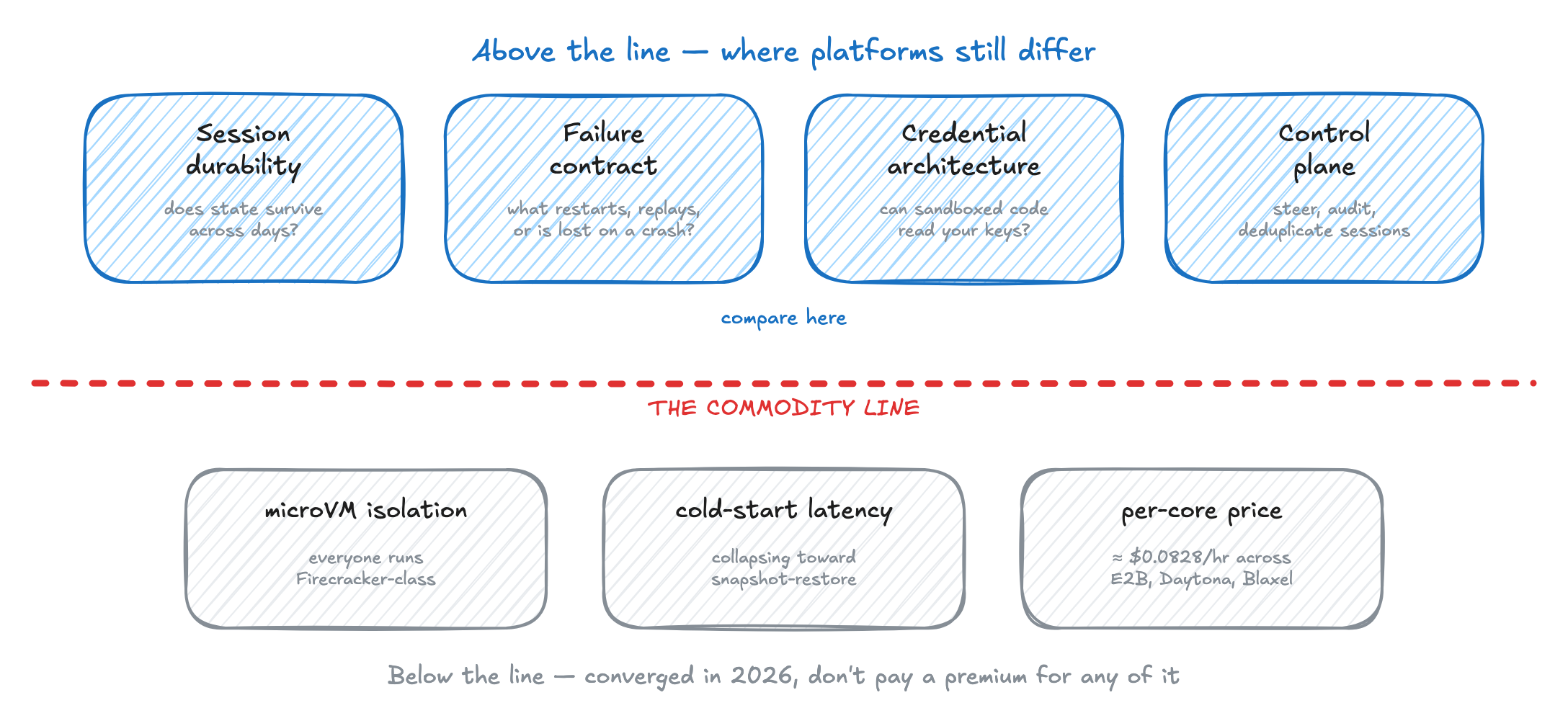
Isolation is the clearest case. Everyone ships hardware-level microVMs now, so it separates nobody.
Cold starts are close behind. Vendors still advertise their milliseconds hard, but snapshot-restore is collapsing the gap. E2B resumes a paused microVM with memory intact in 5 to 30ms instead of booting fresh.
Price is the one row where the stickers differ. Normalized to 1 vCPU and 4 GB, the field spans roughly $0.115 to $0.24 an hour. At agent scale that spread is noise in absolute dollars.
The bill is set by the billing model instead:
- does idle time meter
- does hibernation stop the clock
- do long sessions sit behind a plan gate
Those are lifecycle questions, the same ones the next section covers. The platforms differ there, and getting it wrong costs a migration.
What actually separates the platforms?
Four things: session durability, the failure contract, credential architecture, and the control plane.
Session durability. Will the sandbox your agent works in still exist tomorrow, with its state intact? More of what agents deliver now comes from long-running work: a session accumulates the cloned repo, the installed dependencies, the half-finished changes, and the record of what the agent already tried.
An ephemeral sandbox throws all of that away between runs, so the agent rebuilds its world from zero every time it wakes up. We've made the longer case for keeping sandboxes alive; the short version is that rebuilding context is slow, costs tokens, and loses yesterday's progress.
Platforms differ widely here. Some keep a session's identity through idle time and restarts; others dropped the concept, and when the CodeSandbox SDK got its successor at Together, sessions went with it.
The defaults matter as much as the caps. Daytona auto-stops a sandbox after 15 idle minutes, and a long LLM inference doesn't count as activity, so an agent twenty minutes into a single model call gets stopped mid-task.
The failure contract. Machines fail, and agents now run long enough to be on the machine when it happens. The question is what the platform does next: does the session come back with its work, or is it gone?
This matters most for internal agents because nobody is watching them. Runs started by a schedule or a webhook fail without anyone noticing, and either the platform restores them or someone on your team reconstructs what got done and re-runs the rest.
Three questions cover the contract: what restarts on its own, what work replays, and what is lost for good.
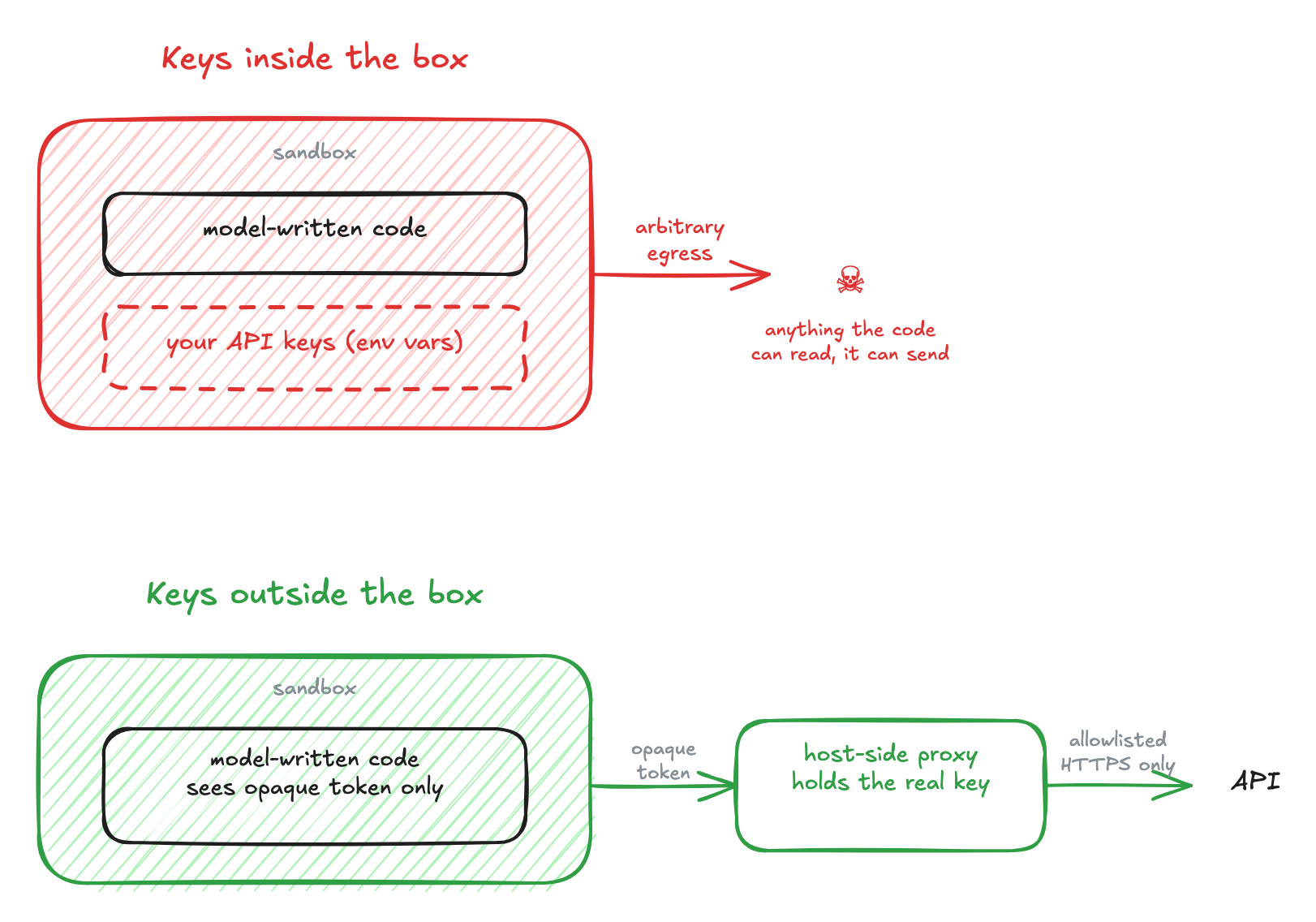
Credential architecture. An internal agent is only useful with access to internal things: your GitHub org, your databases, your APIs. That access comes from credentials, and the code using those credentials is model-written. Where the keys sit relative to that code is a security review question, and platforms answer it differently.
If secrets live inside the sandbox as environment variables, everything the agent can read, a prompt injection can read too. Isolation doesn't fix this: a sandbox with perfect CPU and memory isolation but open network egress will happily send your keys anywhere the code inside asks. We wrote about the credential patterns in more depth in Where Should the Agent(s) Live?
The stronger designs keep real keys outside the box entirely, handing the agent opaque tokens that a proxy swaps for the real thing on allowlisted routes. Platforms differ on whether they give you this or leave you to build it.
The control plane. Once an agent runs for hours instead of seconds, you need ways to operate it: start exactly one when a trigger fires, steer it mid-task, and see what it did afterward.
Starting exactly one needs support from the platform, because webhooks sometimes deliver the same event twice. Unless the platform lets you tag a session with a key and refuse duplicates, that second delivery silently starts a second agent doing the same work.
Seeing what the agent did depends on what the platform records. With an event log per session, the answer is a lookup; without one, it's reconstruction from application logs.
Which sandbox fits which agent?
Here's how the seven platforms score on the four axes, from each vendor's own docs:
| Session durability | Failure contract | Credential architecture | Control plane | |
|---|---|---|---|---|
| Opencomputer | Sessions survive crashes, hibernation, and days of idle under the same ID | Written per failure mode: crash restarts, lost machines replay from the log | Keys never enter the sandbox; proxy swaps opaque tokens | Idempotent create, event log, steering, schedules |
| E2B | Pause/resume up to 24h continuous (Pro); paused state kept indefinitely | Planned paths only; crash behavior not written down | Env vars readable inside; domain-level egress controls | Lifecycle hooks (onTimeout, autoResume), list by state |
| Daytona | VM class pauses with memory; default container class can't pause | Error state with recover() for unplanned errors | Placeholder secrets swapped by proxy; egress firewall | Lifecycle state machine, fork, snapshot, audit logs |
| Modal | No pause; 24h max lifetime; snapshot into a new sandbox | Sharp edges named: processes not restored, snapshots expire | Secrets are env vars inside the sandbox | Lifecycle events, exit-code post-mortems, name-unique create |
| Blaxel | Standby after ~15s idle, sub-25ms resume; expires on lower tiers | Crash behavior not written down | Proxy-injected secrets; code never sees raw keys | External IDs, createIfNotExists |
| Together | Successor SDK dropped sessions | Not written down | Not written down | Not written down |
| microsandbox | Detached mode; memory survival not written down | Yours to write; you operate it | Keys never enter the VM, per the README | CLI lifecycle commands only |
One disclosure before the walkthrough: Opencomputer is my product, so read that section with the skepticism you'd bring to any vendor writing about itself.
Opencomputer
Best for: agents whose session, with its log, its recovery, and its identity, has to survive crashes and days of idle time.
Opencomputer gives each agent a full KVM-isolated VM: persistent filesystem, resizable memory at runtime, ~300ms boots, and hibernation when idle. You can use it as exactly that, a sandbox you start and run commands in.
They also provide an agent sessions API on top of the VM. You define an agent once, then start sessions that you can resume, steer mid-run, and get results back from by webhook. It leads my shortlist because the session layer has a direct answer for each of the four axes.
Durability comes from an event log. Everything a session does gets appended to it, and when a session goes idle, it hibernates; the next message wakes it, with the same sandbox ID and the same filesystem. A client that disconnects reconnects from any point in the log and misses nothing.
Each failure mode also has a documented behavior: a crashed process restarts, a lost machine gets recreated and the session replays from the log, and a hung run stops cleanly.
Credentials stay outside the box. The agent loop and its file and shell tools run in separate sandboxes, and the model key never enters either. Other secrets are sealed into opaque tokens, and a proxy swaps in the real value only on allowlisted routes.
Operating sessions is covered too. You can pass an idempotency key on create, so a redelivered webhook doesn't start a second agent. The event log doubles as the audit trail. Sessions can start from schedules, triggers, and watches, with token and turn limits to bound them.
Pricing is $0.24/hr for 4GB/1vCPU, a higher sticker than E2B or Daytona. You only pay while the session is running, and hibernated sessions don't bill compute, but if raw core-hours are what you're optimizing, pick something cheaper.
A few limits to know about. Recovery resumes from the last committed step, so work after that point can run twice, and your side effects need to tolerate a repeat.
Maturity is uneven across the product. The sessions API is live, but Repos are in preview, Burst sandboxes are alpha, and Browser Sessions are invite-only.
E2B
Best for: agent loops where pause/resume inside a 24-hour window covers the whole lifecycle.
E2B provides managed Firecracker sandboxes with Python and TypeScript SDKs, built around pause as the first-class primitive. You create a sandbox, run code and commands in it, pause it, and resume it later with everything intact.
The key features:
- Pause preserves filesystem and memory under the same sandbox ID, and paused state is kept indefinitely.
- Lifecycle hooks cover the transitions: onTimeout kills or pauses, autoResume wakes on activity.
- Network controls go down to the domain level, with allow and deny lists enforced by a firewall and egress proxy.
On the rubric: durability is pause-based, and the continuous-runtime cap (24 hours on Pro, 1 hour on Base) resets every time you pause, so it fits loops that checkpoint by pausing. The failure behaviors E2B documents are the planned ones, what a pause preserves and what kill does.
Secrets go in as environment variables that code inside can read, so the egress allowlists are what stand between a leaked key and the internet. The session layer above the sandbox is yours to build.
Daytona
Best for: teams migrating off the CodeSandbox SDK.
Daytona is sandbox infrastructure with the fullest lifecycle API in this list, and it shows up in CodeSandbox's own migration guide, which is why it's on most shortlists. Sandboxes come in container and VM classes, and the API covers start, stop, pause, archive, fork, snapshot, and resize.
The key features beyond lifecycle:
- Secrets are placeholder tokens that a proxy swaps for the real value on allowlisted hosts, so plaintext never enters the sandbox.
- Audit logs record every actor and action against every sandbox.
- Egress firewalls take CIDR or domain allowlists, or block all outbound traffic.
On the rubric: durability depends on which class you're on. Container sandboxes, the default, cannot pause at all, and stopping one loses memory; only VM sandboxes pause with memory, and the GPU class can't pause either. Auto-stop defaults to 15 minutes, and background work doesn't count as activity, the mid-inference behavior covered in the durability axis above.
For failures, there's a recovery path for unplanned errors: an Error state with a recoverable flag and a recover() call. Credentials and audit are the strongest of the non-Opencomputer options here.
Daytona is also one of only two platforms in this list with GPU sandboxes, so if your agents need a GPU inside the box, your shortlist is this and Modal.
Modal
Best for: short, high-volume, disposable runs.
Modal is a serverless compute platform where sandboxes are one primitive among many, next to functions, GPUs, and volumes. The model is disposable compute plus snapshots, built for short, high-volume runs.
The key features:
- Sandboxes launch fast at high volume.
- Snapshots capture filesystem or memory state for restore into new sandboxes.
- Network controls include CIDR and domain allowlists plus a full outbound block.
- GPUs attach to sandboxes directly, which only Modal and Daytona offer here, though snapshot-restored sandboxes can't run with them.
On the rubric: there is no pause primitive, and the maximum sandbox lifetime is 24 hours. Past that ceiling you snapshot and restore into a new sandbox, which gets you the old files back but not the same sandbox. Snapshots expire, 30 days by default and 7 for memory snapshots, background processes are not restored, and TCP connections close.
Secrets are injected as environment variables readable by the code you're sandboxing. If your sessions are minutes long and your volume is high, none of these caps cost you anything, and that's exactly the workload Modal is for.
Blaxel
Best for: bursty workloads where scale-to-zero drives the bill.
Blaxel provides sandboxes that scale to zero. About 15 seconds after inactivity a sandbox snapshots memory and filesystem into standby, and it resumes in under 25ms when traffic returns, so idle time costs nothing.
The key features:
- The standby/resume cycle itself.
- Proxy-injected secrets that swap placeholders server-side, so sandbox code never sees raw keys.
- An outbound proxy with configurable firewalls and egress IPs.
- Two good control-plane ideas: external IDs, so the caller owns the keys, and createIfNotExists as the idempotent creation pattern.
On the rubric: durability has two catches. External network connections are not preserved across standby, and standby itself expires on the lower tiers, after 7 days on Tier 0 and 30 on Tier 1. What happens on an unplanned machine failure isn't written down anywhere.
Together Code Sandbox
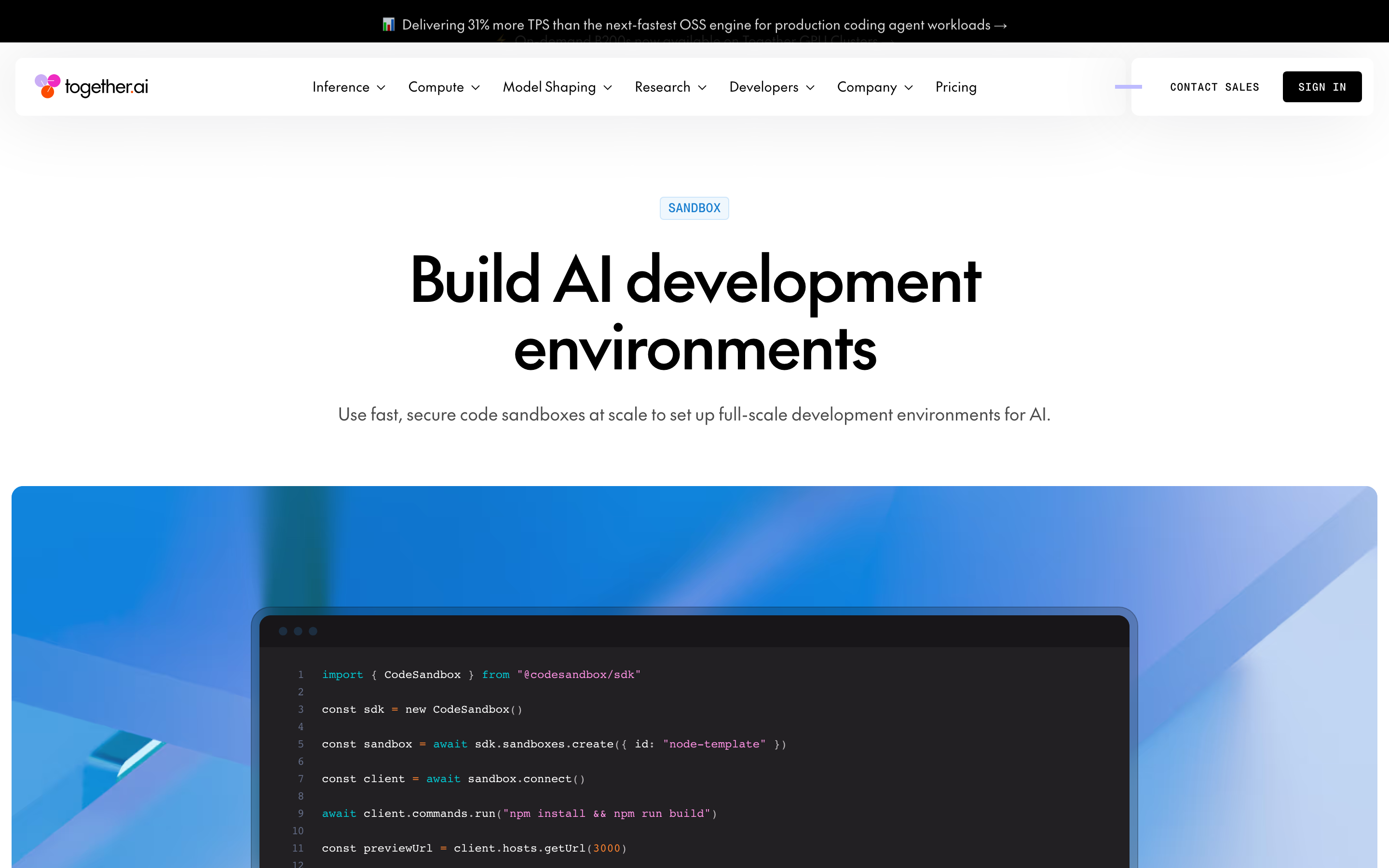
Best for: teams staying on the CodeSandbox lineage who can live without sessions.
Together Code Sandbox is where CodeSandbox's infrastructure lives after the Together AI acquisition, and picking it is a migration decision more than a platform evaluation. Repos shut down fully on July 15, 2026, so staying on the lineage means moving to this SDK.
The key feature is the infrastructure itself: hibernate/resume at roughly 500ms P95, the same layer that ran CodeSandbox's editor. Credit pricing came down about 17% after the acquisition.
On the rubric: the successor SDK drops sessions, list/get, and TTL auto-hibernate, so if you used those, you're choosing a new platform either way. How it behaves on failures, where secrets sit, and what the control plane offers aren't in the docs yet.
Together's own timeline for the remaining migration says only "in the coming months", and self-serve pricing is still billed through codesandbox.io plans.
microsandbox
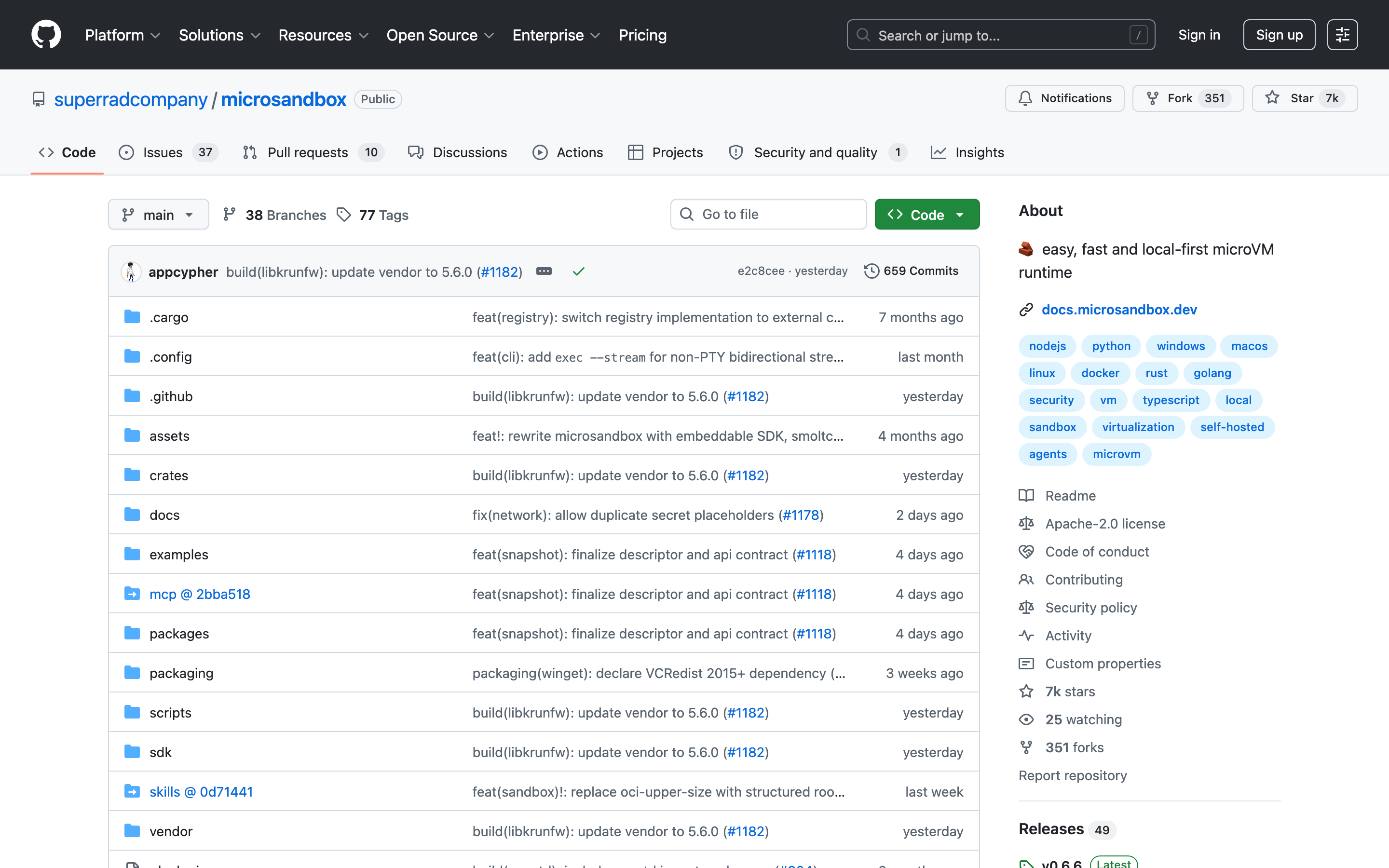
Best for: platform teams that want to own the runtime and operate it themselves.
microsandbox is the build-over-buy answer: an open-source (Apache-2.0) microVM runtime you self-host. You get hardware-level isolation on your own machines, with no per-hour vendor bill and no vendor contract.
The key features, per the README:
- microVM isolation with fast startup.
- A detached mode for long-lived sessions.
- CLI lifecycle and status commands.
- A claim that secret keys never enter the VM, though the project describes itself as beta.
On the rubric: whether memory survives a stop, and what happens on a crash, aren't written down, and self-hosting means whatever contract exists is the one you write. There's no audit or idempotency surface. All four axes become your team's engineering backlog, and for some platform teams owning them is the goal.
FAQ
What matters when comparing AI agent sandboxes in 2026?
Four axes: session durability (does state survive across days, and does the sandbox keep its identity when it comes back), the failure contract (what restarts, what replays, and what is lost when a runtime dies mid-task), credential architecture (whether the code running in the sandbox can read your keys), and the control plane (steering, auditability, and idempotent session creation).
Isolation technology, cold starts, and per-core price have converged across vendors and won't separate them.
Is CodeSandbox still maintained?
Partly. Sandpack is no longer actively maintained, CodeSandbox CI shut down April 15, 2026, and Repos shut down fully on July 15, 2026, while browser sandboxes and Devboxes remain live.
The infrastructure layer lives on as Together Code Sandbox under Together AI, which cut credit pricing about 17% after the acquisition and says remaining features migrate "in the coming months".
What is a durable agent session?
Per Opencomputer's docs, a session is "an agent run with an append-only event log, a pinned configuration snapshot, and a lifecycle status". In practice that means the event log is the durable record, clients reconnect from any point without gaps, and idle periods or crashes don't end the run.
Why not just run Docker containers?
You can, and plenty of teams do. The case for microVMs instead: containers share the host's kernel, so a kernel exploit in one container compromises every other container on that machine. Hardware-level VMs remove that attack surface, which is why every managed platform in this piece runs them.
Whether that risk matters for your threat model is your call.
Are sandbox benchmark numbers reliable?
Mostly no. The same platform shows up at different cold-start numbers depending on which comparison you read, because the figures are vendor-published and measured under different conditions. Session caps, retention windows, and recovery semantics are written commitments in each vendor's docs; latency is something to measure on your own workload.